-Photoroom.png)


Transferring Your F-1 to Dallas from Another State: How to Move to Texas Without Losing Your Student Status
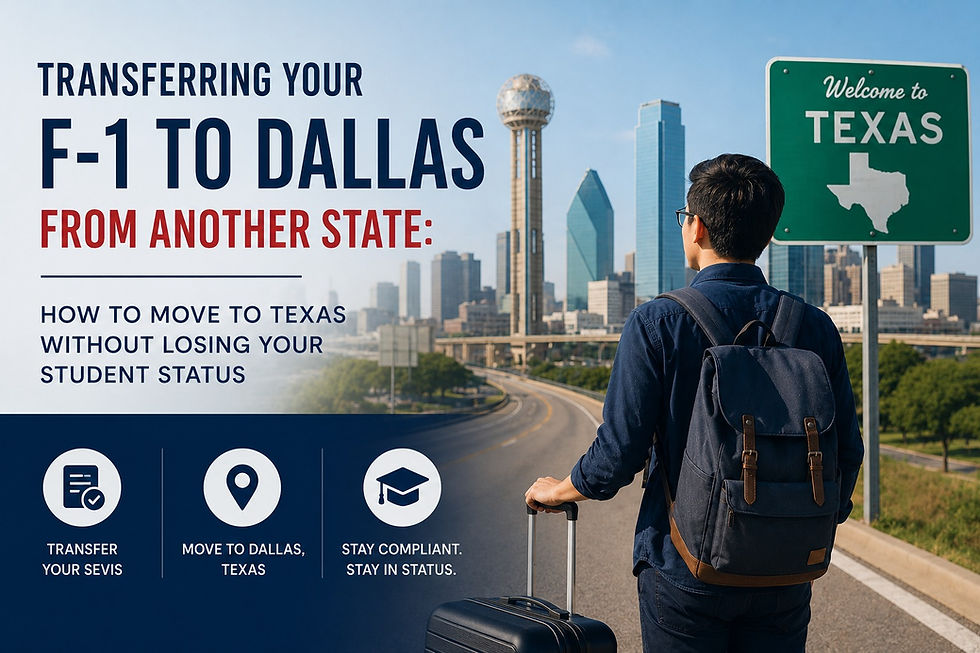
Over the past few years, Texas has become one of the most attractive destinations for international students already living and studying in the United States. The reasons are straightforward: the cost of living is significantly lower than in New York or California, the job market is growing, and Dallas - one of the largest cities in the country - offers a large international community, solid infrastructure, and direct flights to most parts of the world.
But students on F-1 visas immediately run into the same question: "Can I just move to another state?" The answer is yes - but it has to be done correctly, or the move can result in losing your student status entirely.
Can You Move to Another State on an F-1 Visa
Yes. An F-1 visa doesn't tie you to a specific state or city - it ties you to a specific school and your SEVIS record. Moving from New York to Dallas, from Florida to Texas, or from California to anywhere else in the country is completely legal. The only requirement is that you continue studying at an accredited SEVP-certified school and complete the transfer properly.
Moving without a proper SEVIS Transfer is a violation. Your status is tied to the school that issued your I-20. If you simply leave and stop attending classes, your school is legally required to report this to SEVIS - and you'll be out of status.
What Is a SEVIS Transfer and How Does It Work Across State Lines
A SEVIS Transfer is the official process by which your student record - your SEVIS ID - moves from one school to another. From USCIS's perspective, this is exactly what any student changing schools is supposed to do, whether they're moving across town or across the country.
The process works like this:
Step 1. You choose a new SEVP-certified school in Dallas and submit an application.
Step 2. The new school issues you a new I-20 marked "Transfer Pending."
Step 3. You notify your current school of your Transfer Release Date - the date on which
your SEVIS record officially moves to the new school.
Step 4. On or before that date, your current school releases your SEVIS record.
Step 5. The new school activates your record, and you begin your program.
Throughout this process, your status remains active. That's the key advantage of a SEVIS Transfer compared to, say, leaving the U.S. and reapplying for a visa from abroad.
When Can You Transfer and Are There Timing Restrictions
You can initiate an F-1 transfer at any point while you're in active status. There's no minimum time requirement - you don't have to wait until the end of a semester or academic year.
That said, there are several practical timing considerations:
The Transfer Release Date must be in the future. You cannot set a backdated transfer date. Your current school can only release your record going forward.
Until the Transfer Release Date, you're still officially enrolled at your current school. This means you're technically required to attend classes there until that date. Leaving early without DSO approval is a violation.
After the Transfer Release Date, you have up to 15 days to register at the new school. If you miss this window, your status will be terminated.
Why Students Are Moving from Other States to Dallas
Over the past few years, a clear pattern has emerged: students who started in New York, Los Angeles, Miami, or Chicago are increasingly choosing to transfer to Dallas. The reasons vary, but they consistently come down to a few core factors:
Cost of living. Rent in Dallas is roughly two to three times lower than in New York or San Francisco. On a student budget, that's not a minor detail - it's the difference between managing and struggling.
No state income tax. Texas is one of a handful of states with no state income tax. For students who plan to work after receiving work authorization, this is a meaningful long-term advantage.
A growing job market. Dallas is one of the largest business hubs in the country, with active growth in technology, finance, logistics, and healthcare. Students think ahead, and Dallas offers a strong professional landing pad.
A large international community. The Dallas–Fort Worth area is home to hundreds of thousands of people from Latin America, Asia, and the Middle East. The adjustment is easier when you're surrounded by people who've made the same journey.
Global connectivity. DFW International Airport is one of the busiest in the world, with direct flights to most countries international students come from. Getting home - or having family visit - is straightforward.
Documents Needed for a SEVIS Transfer to Dallas
Here's what you'll typically need to complete the transfer:
Valid passport
Current I-20 from your existing school
Copy of your F-1 visa
Acceptance confirmation from the new school (Acceptance Letter or Transfer Pending I-20)
Financial documents (bank statements or sponsor letter)
Payment history from your current school
No additional filings with USCIS are required when transferring between schools. The entire process happens within the SEVIS system, between the two schools.
What Happens to the Visa in Your Passport When You Transfer States
This is a common question, and the answer reassures most students: the visa in your passport remains valid. Transferring from one SEVP-certified school to another does not require you to obtain a new visa.
The only situation that would require a new visa is if you leave the United States and return after your visa has expired. But as long as you stay in the country throughout the transfer process, your existing visa continues to be valid.
What Student Life in Dallas Actually Looks Like
For those moving from another state who want to know what to expect on the ground:
Housing: a one-bedroom apartment in student-friendly neighborhoods runs from around $900 to $1,400 per month - significantly cheaper than comparable cities.
Transportation: Dallas has a DART rail and bus system, but most residents use a car. Students moving from New York often cite this as the biggest lifestyle adjustment.
Food: diverse and relatively affordable, from Mexican to Asian cuisine. Grocery prices are noticeably lower than in most large northern cities.
Safety: Dallas is a large city, and neighborhoods vary - as they do anywhere. Lingua Prime is located in the Medical District / Northwest Dallas area, one of the more professional and well-connected parts of the city.
Lingua Prime Dallas - Built for Students Who Transfer from Other States
We handle interstate transfers regularly. Students come to us from New York, Florida, Illinois, California, and beyond - and every time, the process is the same: clear, organized, completed in real time.
Address: 1327 Empire Central Dr STE 118, Dallas, TX 75247
CEA-accredited, licensed by the Texas Workforce Commission
SEVP-certified - authorized to issue I-20 forms
Transfers from any U.S. school — processed within a few business days
Multilingual staff: Russian, Spanish, Arabic, and more
Flexible schedules: mornings (9 AM–2 PM), evenings (5 PM–9 PM), weekends (9 AM–7 PM)
IEP tuition for F-1 students: $1,500 for 12 weeks
If you're thinking about moving to Texas and want to understand how to do it correctly - message us on WhatsApp or call 945-394-0177. We'll walk you through the process step by step, answer your questions about documents and timelines, and make sure your transfer goes smoothly.


Комментарии